Using GPS and telematics data to calculate fuel tax credits means measuring where and how your vehicles actually operated, instead of estimating. That matters because fuel is treated differently depending on whether it was used on public roads, off public roads, or to power auxiliary equipment. Measuring the split precisely lets you claim the higher off-road and auxiliary rates with confidence, capture eligible use you might otherwise miss, and evidence every figure if the ATO reviews your claim.
Nuonic analyses the GPS positions and event data recorded by your existing telematics devices to work out this apportionment: the portion of activity and fuel that occurred on public roads, off public roads, and operating auxiliary equipment. This page explains how that process works. Each telematics system is different, so the treatment of data can vary with the attributes and operating parameters of the system.
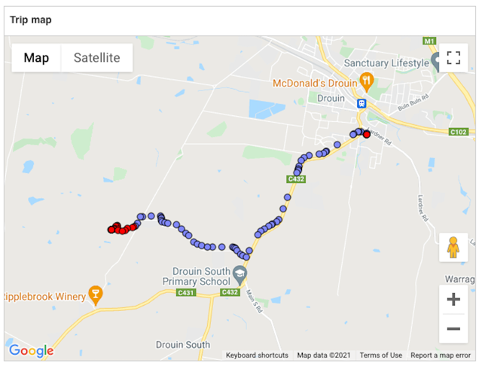
An example of a trip after the classification process, showing positions determined to be on public roads (purple) and off public roads (red).
Aligning to commonly accepted FTC methods
The apportionment Nuonic produces is designed to slot into the methods the ATO already accepts. The ATO sets out fair and reasonable apportionment methods in Practical Compliance Guideline 2016/8, and Nuonic's output can be used within any of them. This document describes several methods of fuel apportionment that are considered fair and reasonable when used correctly and with the right supporting records.
Since its publication there have been further releases providing more detail related to record keeping, using GPS-based technology and handling specialised cases such as auxiliary equipment.
Nuonic is designed to provide an objective and transparent apportionment of vehicle activity and fuel use that provides information that could be used within any of the commonly accepted methods. Nuonic does not provide an opinion on which method is appropriate for any specific case. Our team continually seeks to improve this capability so it satisfies client and ATO expectations about what is fair, reasonable, and accurate.
Nuonic is not a registered tax agent and does not provide tax advice. We recommend that all users of our software products seek professional tax advice in relation to FTC claims.
The calculation process
The calculation process occurs in two stages. The first stage results in apportionment of activity and is dependent only on the recorded positional information provided by telematics devices.
To calculate Activity Apportionment, Nuonic executes the following steps:
| Step | Action | Description |
|---|---|---|
| 1 | Obtain vehicle, GPS position and event data from telematics devices. | Nuonic uses integrations with telematics providers to access client data through structured and consistent processes, including REST APIs and automated file transfers. |
| 2 | Filter and clean the data. | Nuonic applies various data validation and cleaning steps to remove anomalous or incorrect data. |
| 3 | Arrange the data into trips. | Nuonic aligns the data into defined periods of vehicle activity based on movement, ignition state, and other identifiers. |
| 4 | Determine the state of the vehicle at each position. | Nuonic uses sequential position and event data (source-system dependent) to determine vehicle state at each point in time. |
| 5 | Classify the location type at each position. | Nuonic compares each position to national mapping data to determine if it is on a public road or not. |
| 6 | Calculate inter-position attributes. | Further calculations relate to the changes from one point to the next, such as distance travelled and time interval. |
| 7 | Aggregate to trip-level metrics. | Position-level data is aggregated to trip-level summaries for each trip and vehicle under analysis. |
| 8 | Calculate distance and time apportionments for each trip. | Each trip is split into aggregate components for FTC-relevant activities. |
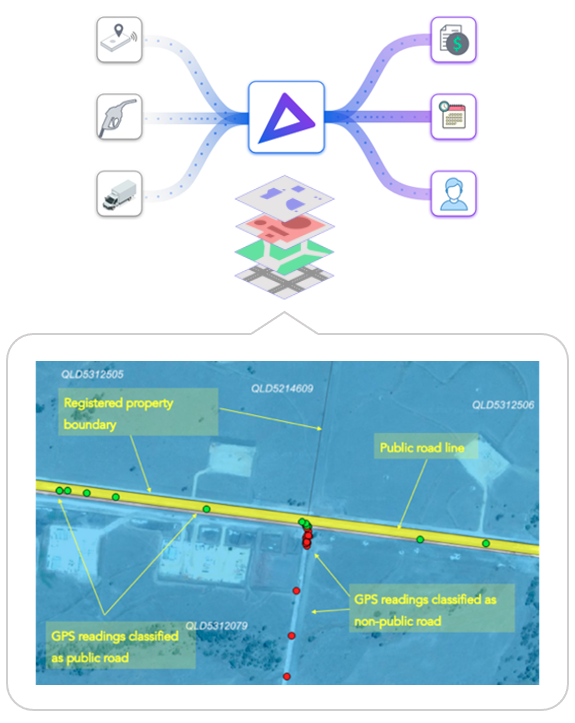
Conceptual image of comparing GPS positions in a trip to public road objects in mapping data to determine location status.
The second stage converts activity to an apportionment of fuel use. This stage requires additional information to convert activity to fuel use, most importantly fuel consumption rate assumptions that are set on a per-vehicle basis in the Vehicle Register.
It is important to understand that the relationship between vehicle activity and fuel use is often non-linear. This is because fuel consumption rates and units of measurement are different for each activity type. Driving fuel consumption is measured in L/100km whereas idling fuel consumption is measured in L/hour. Also, distance as a measure of activity does not include any component of idling, yet many vehicles idle for material amounts of time at the start and end of journeys and when operating auxiliary equipment (such as PTOs).
Nuonic also provides methods for inputting actual fuel amounts, which ensures that amounts reported in fuel apportionment results equal amounts you have purchase evidence for.
FTC amounts are then calculated by applying the relevant FTC rate to the fuel used across each section of activity. FTC rates are recorded in Nuonic and updated as released by the ATO (typically 3-4 times per year).
FTC amounts are implied amounts only, meaning they are a calculation result assuming all other inputs and settings are correct, but Nuonic does not provide assurance that this is the case.
To calculate Fuel Apportionment and implied FTC amounts, Nuonic executes the following steps:
| Step | Action | Description |
|---|---|---|
| 1 | Convert distance and time apportionments to fuel use. | Using fuel consumption rates for each vehicle, Nuonic estimates fuel used within each activity increment and for each aggregated activity section. |
| 2 | Aggregate fuel use to totals per trip per activity type. | This produces fuel totals per trip for driving and idling on public and non-public roads. |
| 3 | Apply the relevant FTC rate to produce an implied FTC amount. | The rate is selected based on time period, vehicle fuel type in scope, and activity type, resulting in a dollar amount accrued for each section. |
The results of both calculation stages are then used to generate monthly reports distributed to users. Trips can also be visualised in the Trip Viewer and used to compile audit reporting outputs.
Auxiliary fuel use
Vehicles that operate auxiliary equipment, such as cement mixers, crane arms, and fuel pumps, may be able to include a separate FTC component within a claim for fuel used to power auxiliary equipment. The ATO allows taxpayers to decide the appropriate calculation method, which may include direct fuel-use calculation and simplified methods ("safe harbours"), as described in ATO guidance.
Nuonic aims to accommodate all options for clients by allowing selection from the following options for applying auxiliary fuel use on a per-vehicle basis, device capability permitting:
| Vehicle setting | Calculation applied | Use case |
|---|---|---|
| None | No auxiliary fuel use is assigned to the vehicle. | Default setting. |
| Calculated | If auxiliary-operation events are recorded by the telematics device (usually via additional sensors), an estimate of auxiliary fuel use is calculated based on event operating time and a specified auxiliary fuel consumption rate. | Available only with selected telematics devices and sensors. |
| Percentage | If a client has other (non-telematics) records that enable a fair and reasonable percentage apportionment, they can enter this amount and Nuonic will include it in apportionment. This applies to auxiliary use only and does not prevent a separate non-public road component being calculated. | For cases where auxiliary fuel use is measured but data is not available via telematics devices. |
| Safe harbour | If a client chooses a safe harbour rate, they can enter the relevant percentage and Nuonic will include it in apportionment and prevent any separate non-public road component from being included. | For cases where the client prefers the simplified ATO approach. |
See it on your own fleet
Nuonic turns your existing telematics and fuel data into this apportionment automatically, with results that trace back to every GPS position for audit. You get a defensible off-road and auxiliary split without the manual work.
Get started, or see how to create and view your GPS-calculated FTC reports.
Risk management and governance
Nuonic combines advanced technical data analysis with a client service overlay. Both components must work together to provide accurate and reliable outputs for users, and this requires adherence to guiding principles that govern how Nuonic designs, implements, and operates the platform.
These principles are:
- The calculations executed by Nuonic are objective, focused on accuracy given the inputs and settings applied.
- All inputs, outputs, system events, and user interactions are traceable back to their source, to the full practical extent.
- Data sourced from telematics systems is considered accurate and reliable unless identified otherwise by validation processes or user specification.
- Data entered by users is considered accurate and reliable.
- All results are transparent, and any information entered or produced by Nuonic is made accessible to users.
- Public and non-public classification in the context of FTC is global. It is not possible for the same spatial position to have different classifications for different clients.
Our team continuously works to improve the system and develop information and tools to help users get the best results. Due to the high volume and complex nature of GPS data analysis there is always some risk that incorrect data is obtained, used, or produced, so users should review results and provide feedback.
To mitigate these risks, Nuonic implements the following measures related to commonly occurring issues that can result in incorrect activity and fuel apportionment:
| Objective | Approach |
|---|---|
| Ensuring input data quality | Vehicle activity data, specifically GPS position records, must meet quality criteria to be accepted as valid inputs. Criteria include: device ID present, valid timestamp with minimum 1-second resolution, and valid latitude/longitude values to at least 5 decimal places. Nuonic includes filtering and analysis functions to assess validity. Many telematics systems also perform their own raw-data validity checks before exposing data via APIs. |
| Ensuring accuracy of GPS positions | GPS position accuracy depends on telematics device performance. These devices are not modifiable or controllable by Nuonic once installed. Positions used in processing can be visualised in the Trip Viewer, and full point sets can be downloaded in audit outputs for independent evaluation. Nuonic also applies algorithms to identify positions outside realistic travel trajectories. |
| Avoiding incorrect distance measurements | Nuonic uses odometer or other direct readings when available, otherwise it calculates GPS distance using inverse geodetic computations. Where readings are outside realistic trajectory bounds, Nuonic may exclude positions or raise errors for investigation. |
| Avoiding inaccurate ignition state readings | Nuonic uses various data attributes to indicate ignition state, depending on device capability. Typically this includes reliable ignition indicators and may also use engine rotations, battery voltage, distance, speed, and other status indicators to form comprehensive ignition-state derivation. |
| Avoiding incorrect idling time | Nuonic applies several methods to validate idling times (device capability dependent), including: comparison to aggregate reported trip metrics, comparison of multiple point attributes, optional process-control parameters to limit idling or exclude outlier trips, and monthly reviews of idling/activity statistics across active accounts to identify anomalies. |
| Avoiding incorrect non-public road point classification | In addition to mapping data maintenance controls, Nuonic provides tools and algorithms to validate non-public classification, including: requiring a minimum of four consecutive off-public roads points (except at trip start/end), interactive Trip Viewer access, audit outputs that identify top off-public roads locations, and full access to classified point sets for independent geospatial analysis. |
| Avoiding invalid trip records | Users can automatically (rule/threshold based) or selectively exclude individual trip records from reporting when source systems provide a small amount of realistic but incorrect data (for example, missing crucial positions). |
| Avoiding inaccurate fuel consumption rates | Fuel consumption rates are user inputs because most vehicles do not provide rates in the required form (separate driving and idling rates). Users set rates in the Vehicle Register. Recommended methods include advanced ECM diagnostics during maintenance and real-world measurement of actual vehicles for driving and idling periods. Demonstrably fair and reasonable alternatives may also be appropriate. |
When configuring a Nuonic client account, default fuel consumption rates are applied based on vehicles first listed in the Vehicle Register. These are generic starting values by vehicle category and are intended to help clients begin setup and demonstration.
As part of onboarding, Nuonic walks clients through Vehicle Register usage and outlines client responsibilities for input data and settings, including fuel consumption rates.